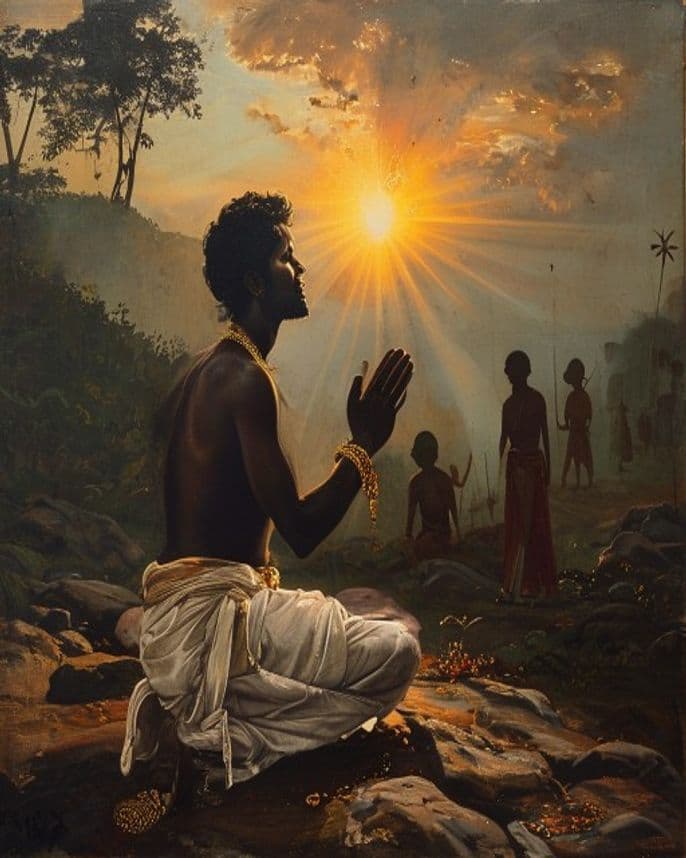
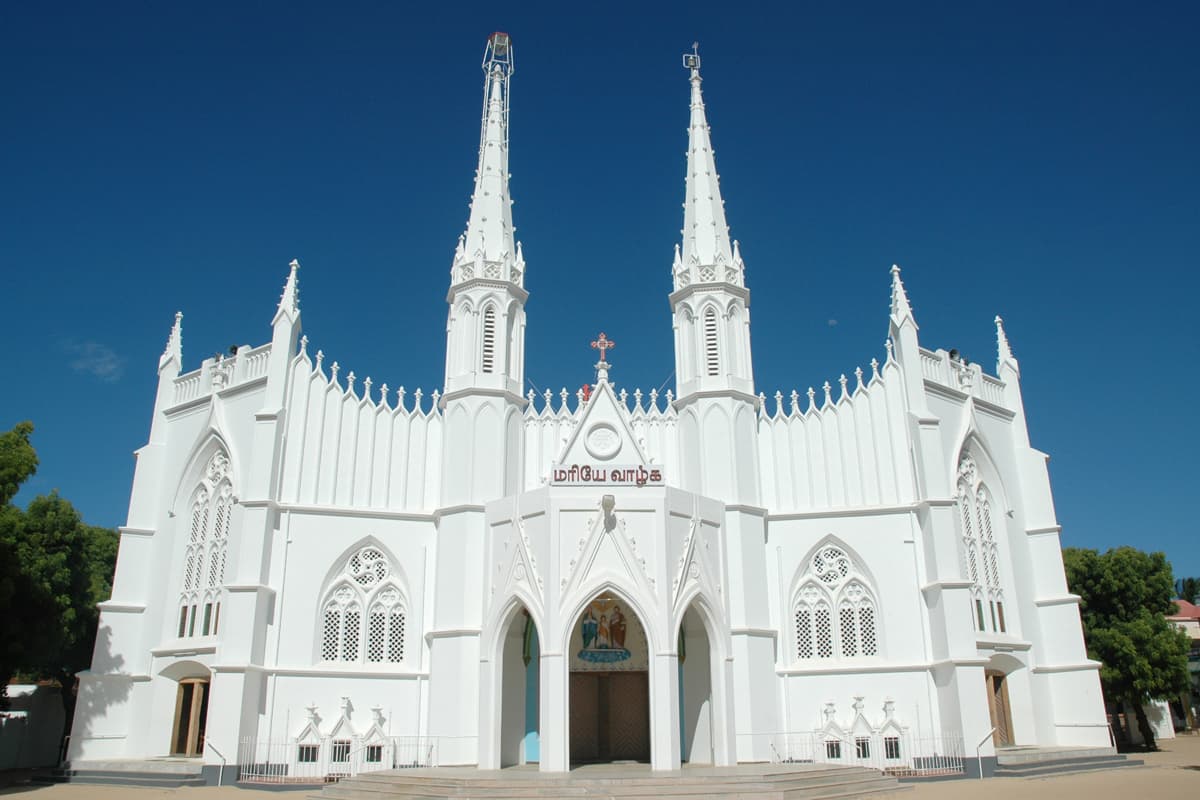
The officer of Travancore who came to this church in 1745 to be baptised — a baptism the Holy See's own record places here, by name. He was shot for the faith at the Aralvaimozhi lines in 1752 and canonised in 2022, the first layman of Indian birth raised to the altars. His wife lies in this parish's ground.
Devasahayam — “God is my help”
Feast — 14 JanuaryCanonised 15 May 2022 by Pope Francis
Birth name
Neelakanta Pillai — born 23 April 1712 at Nattalam, in Travancore
In the king's service
Officer of King Marthanda Varma; he “held office in the court of the Raja”
Brought to the faith by
Eustachius De Lannoy, the Fleming who commanded Travancore's armies
Instructed
Nine months, by Fr Giovanni Battista Buttari, S.J., of this parish
Baptised
14 May 1745, at the church of Vadakkankulam — the place recorded by the Holy See
The name he took
Devasahayam — “God is my help”, the Tamil for Lazarus
Arrested
23 February 1749; about three years in chains
Martyred
The night of 14–15 January 1752, shot at the Aralvaimozhi lines; buried at Kottar
Canonised
15 May 2022, St Peter's Square — the first layman of Indian birth to be canonised
There is no cause for delay. This is no compulsory baptism. I came here to receive the sacraments not by force, but by my own free will and desire. I shall even give up my life to maintain the Truth of which I received the light and of which I am convinced.
What he answered at this font when Fr Buttari hesitated — set down by C. M. Agur, a Protestant historian of Travancore, in 1903. A nineteenth-century writer reporting an eighteenth-century conversation: transmitted speech, not a minuted record
His Life
From the Court of Travancore to the Lines at Aralvaimozhi
Forty years, of which the last three were spent in chains. What follows is told from the books, and each chapter says what it rests on.
01
A Soldier of the King
He was born Neelakanta Pillai on 23 April 1712 at Nattalam, in the kingdom of Travancore, and entered the army of King Marthanda Varma in 1729. He rose to high office at the court and was entrusted with command. A British administrator writing the religious history of Travancore in 1901 — a Protestant with no interest whatever in this parish — records him plainly as a man who “held office in the court of the Raja”, and gives his age at his conversion as thirty-two. Then came a run of reverses: livestock dead, crops ruined, losses that rank and royal favour could do nothing about, and a sorrow that settled on him and would not lift. The priest who later instructed him called him, simply, melancholic.
Eustachius De Lannoy had arrived in Travancore as an enemy. Taken prisoner at Colachel in 1741, he was brought into the king's service instead of executed, and rose to command his armies; he was also, the chronicles say, “a most excellent Christian”. To the grieving officer beside him he spoke of the imperishable goods promised to those who serve the one true God, and he told him the story of Job — a man stripped of everything who did not let go. The words fell on him, the old account remembers, “like a heavenly balm”.
De Lannoy sent him here with a letter of recommendation, to Fr Giovanni Battista Buttari, the Jesuit then serving the Christians of Vadakkankulam. Buttari instructed him for nine months and was in no hurry: he foresaw exactly what a conversion at that rank would cost — the anger of his own people, the enmity of the court, the certain loss of his office — and judged it necessary to defer the grace. The man's answer was that having found the true God he would not leave him, though it cost him every advantage of this world and life itself. On 14 May 1745 Fr Buttari baptised him and gave him the name Lazarus, which in Tamil is Devasahayam: God is my help.
This is the best-attested fact this village possesses, and none of it comes from us. Vatican News names “the Catholic church of Vadakkankulam village”. L'Osservatore Romano — in a notice written by the Vice-Postulator of the cause — names the priest, the nine months and the day.
Note14 May is the best-attested date; a minority of canonisation-era accounts give 17 May. Note also that the rite of canonisation itself recites only the name: the place and the date come from the Holy See's biographical record, which is why this page says the baptism here is recognised by the Holy See, and never that it was proclaimed at the canonisation.
His godfather was this parish's own catechist, Gnanaprakasam Pillai. He had been Chidambaram Pillai, a temple priest of Vittapuram near Palayamkottai, and he was on pilgrimage to Cape Comorin with his wife when, somewhere near this village, he heard the sound of a church bell. He followed it to the chapel of the Holy Family, found the Mass being said, asked for instruction, and was baptised — taking the name Gnanaprakasam, the light of knowledge, his wife taking the name Anandai. A house was built for him here and he was made catechist, travelling with the missionary through Travancore and the Pandiyan country. Years later he stood as godfather to the martyr. He is also, as it happens, the man to whom one modern scholar attributes the establishment of this church, in place of de Britto.
NoteThe parish's own history dates his conversion to the time of Fr Prosper Giuliani, 1728–33, and elsewhere heads the same entry 1743. That is an inconsistency inside the parish's own record rather than a dispute between sources, and it is left standing.
Fr Buttari was building a church and was short of wood for it, and he asked Devasahayam to go and obtain the timber from the king's government. The errand brought him before a man of great credit at court who had long been his friend — and who used the meeting to demand that he give up his new faith. A dispute followed, and the friend lost it. Humiliated, he swore: “Either I will make you renounce your religion, or you will pay for it with your head.” Devasahayam answered him in kind, and the insult was never forgiven. The whole storm broke, in the end, over a request for building timber.
NoteMismatch, and both readings are kept. The parish has always told this as the timber for the church HERE — which is why it holds that its own building and the martyrdom are bound together at the root. Besse, the mission's own historian, writes instead that Fr Buttari was building a church for the community at Nemam, and sent him to the prime minister, Rama Ayan Dalawa, for that wood. Nothing on this page decides between them.
The warrant was got from the king by intrigue. Devasahayam surrendered without resistance and asked only to say goodbye to De Lannoy. “Courage,” the captain told him; “the moment has come to prove you are a worthy soldier of Jesus Christ.” A missionary was brought to him secretly to hear his confession. Brought before the king he confessed Christ and was sentenced to death — and then the sentence was lifted, the auguries having declared that the execution would bring calamity on the kingdom. The chronicle records the convert's reaction to his own reprieve: he was in great regret, “fearing for a moment that God did not judge him worthy of the crown”.
Unwilling now to kill him but set on breaking him, the king had him carried from village to village with his hands bound behind him, mounted on a buffalo and garlanded with erukku, the crowds urged to abuse him as he passed. He took it, says the chronicle, as a share in the humiliations of his Saviour. Then came the beatings — rods set with thorns until his body was one wound, and ground pepper rubbed into the cuts. To all of it he said only: “O Jesus, it is for love of you that I suffer”, and sometimes added, “and for the expiation of my sins.” When they ground the powder into his face he told them not to spare his eyes, “for in my youth they were instruments of sin.”
NoteThe chroniclers also tell that when his guards gave him sea-water on the burning sand he drank it and found it fresh and without bitterness. That is told as a wonder in a devotional life, not as an investigated miracle, and the page passes it on as exactly that.
Shut in a dungeon at Trivandrum he drew such crowds — Christians and the merely curious, whom he never failed to teach — that the king had him taken out at night to a desert place three leagues off and chained to a tree, unable to take a step or even to stand upright. He stayed so for seven months, in the sun and in the storms, until his guards were moved to pity and lengthened the chain and raised a thatch over him. He used that small liberty to write to De Lannoy, telling him where he was and asking for a priest who would bring him “the Bread of the strong”. De Lannoy did as he asked, and the Eucharist came to him in the wilderness. Word of the place spread, and the desert became a pilgrimage.
Unable to silence the crowds, the king at last pronounced the sentence. Soldiers came in the middle of the night and told him he was being moved to another prison. “Why do you dissimulate?” he answered them. “I know where you are taking me; let us go without delay.” At the place he asked for a few moments to pray, then rose: “I have done my duty; it is for you to do yours.” They shot him — the Vice-Postulator's account says five bullets — and he fell pronouncing the names of Jesus and Mary, and a second volley finished it. It was a little before midnight, between the fourteenth and the fifteenth of January 1752, at the Travancore lines by the Aralvaimozhi gap.
NoteTwo things this page will not smooth over. The spot is universally called Kattadimalai today, but no source of the period names it — the witnesses describe the lines at the Aralvaimozhi gap and go no closer than that. And Auguste Jean's text of 1894 prints the year as 1742, which is impossible against a baptism in 1745; the Holy See's own “Lazarus, known as Devasahayam (1712–1752)” settles it.
His body was gathered up and carried to Kottar, near Nagercoil, and buried in the church of St Francis Xavier. The Te Deum was sung for him in the cathedral at Cochin, and the bishop preached the panegyric himself. This parish wanted him. A Malayalam life of the martyr, printed in 1930, records why it did not get him: there was no royal order permitting a body to be carried out of the kingdom, and so the intention of bringing Devasahayam Pillai's sacred body to Vadakkankulam “could not be achieved.”
NoteThat Malayalam life of 1930 is not in the shrine's bibliography — it surfaced only when the corpus was searched in Malayalam script — so it carries no chip below. It is recorded here as what it is: one late witness to an intention.
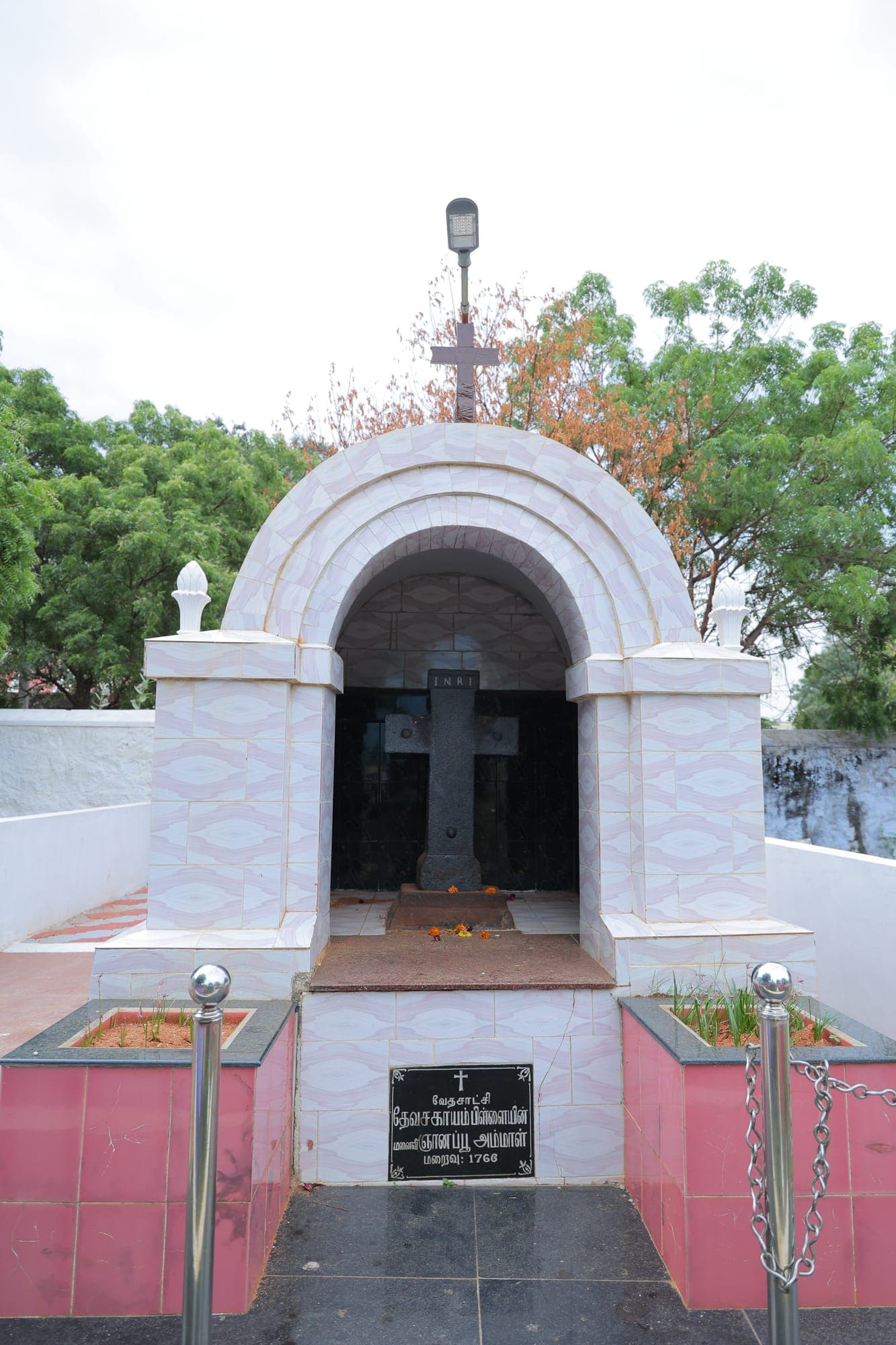
His wife was Bhargavi Ammal, baptised here after him with the name Theresa — in Tamil, Gnanapoo, the flower of knowledge. Eight days before his death he sent her word to hold to the faith, and to settle at Vadakkankulam. She did. She died in 1766 and lies in the parish's own ground, and her tomb is still standing: the Tamil plaque names her as the wife of the martyr Devasahayam Pillai and gives the year of her death — a date no book on this project supplied. An old black cross cut with INRI stands in the arch behind it, plainly older than the tiled surround built around it since.
NoteThe stone calls her Gnanappu Ammal; Ammal is the Tamil honorific, “lady”. Theresa is her baptismal name from the written sources. Both are right, and neither should be “corrected” into the other.
The cause was opened as a diocesan inquiry in 1993 and closed in 2008; Rome found it valid in 2010. He was declared Venerable on 28 June 2012 and beatified at Nagercoil on 2 December 2012, before something like a hundred thousand people. A healing in 2013 was recognised as the miracle on 21 February 2020. On 15 May 2022 Pope Francis canonised him in St Peter's Square, one of ten that day — “Lazzaro, detto Devasahayam” — the first layperson of Indian birth ever raised to the altars; forty-nine people of this parish were in Rome to see it, led by their parish priest. And on 15 October 2025 he was proclaimed Patron of the Laity in India.
This shrine cites its sources, and it will not dress a tradition as a document. On this page the balance falls the other way from the founder's: nearly everything here is externally documented, and the few things that are not are named as such.
Documented
The strongest fact this village has
That he was baptised at this church, in 1745, by Fr Buttari. Vatican News names the church; L'Osservatore Romano, in a notice by the Vice-Postulator of the cause, names the priest, the nine months and the day; and the canonisation of 15 May 2022 seals “Lazarus, known as Devasahayam (1712–1752)”. Alongside the Holy See stand two Protestant historians of Travancore, Mackenzie in 1901 and Agur in 1903, who had no reason on earth to flatter a Catholic parish and who independently give the man's standing, his age, the place — and his own words at the font.
Parish tradition
What descends from a single telling
The tortures in their detail, the sweetened sea-water, the seven months on the chain, the words spoken on the last night. These reach us through the Jesuit chroniclers writing a century later — Bertrand in 1847, Auguste Jean in 1894 — and both descend from Fr Buttari's own manuscript account of the man he had baptised. They are one witness family, however many books repeat them, and the page does not stack them to look like corroboration.
Parish tradition
Where the sources disagree
The timber: the parish says it was for the church here, Besse says it was for Nemam. The place of death: everyone now says Kattadimalai, no source of the period names it. And the relic. Auguste Jean, writing in 1894, says this church holds “a part of his garment and the chains with which he was bound”; the 1915 genealogy of the village's catechist families says a turban and a sword; another scholar says a turban and a shawl; the diocese today speaks of the turban. The chains, at least, are accounted for — they were not lost, but given to Rome for the cause.
The parish's claim on him needs none of the doubtful parts. He came to this church to be baptised, and he went out from it to die.
Our Parish Bond
Why Vadakkankulam Holds Him as Its Own
Devasahayam belongs to the whole Indian Church now. But four things about him are ours and can be nobody else's: the font, the errand, the grave in our ground, and the relics on our altar.
01
Baptised at this font, 1745
Not parish memory — the Holy See's own record of the cause names this church as the place, and gives the day. Whatever else is uncertain in three hundred years of this village's history, this is not.
02
It began with timber for a church
The errand that destroyed him was a request for building wood. The parish has always held that the wood was for this church, so that its own walls and his martyrdom begin in the same moment — though the mission's own historian puts that church at Nemam, and the page says so.
03
His wife is buried in our ground
Eight days before he died he told Gnanapoo Ammal to keep the faith and settle here. She did, she died in 1766, and her tomb stands in the parish cemetery with its old stone cross — the one thing in this story you can still walk up to and touch.
04
His relics are kept here
As long ago as 1894 a Jesuit historian recorded that the church of Vadakkankulam possesses a part of the garment he wore and the chains with which he was bound. They have been on this ground since the year he died.
In This Parish
Devasahayam Today
The saint canonised in Rome in 2022 is kept here in three ordinary, continuous ways.
The relics
A part of his garment and his captivity chains have been kept at this church since his death — attested in print as early as 1894. The diocese today speaks of the turban among them; the chains themselves were taken to Rome for the cause, which is where they went and not, as is sometimes said, lost on the road.
His grotto, and his statue
A St Devasahayam grotto stands at Mangammal Salai in the parish. In the Calvary chapel of the Apparition shrine his statue was set up beside Arulanandar's under Fr Thadeus Rajan, parish priest from 2013 to 2018 — the man baptised here and the man the parish counts as its founder, side by side.
Two days in the year
14 January is the martyr's feast, kept wherever he is honoured. 14 May is the day he was baptised — and that day belongs to this church in a way it can belong to no other.
Sources
This page is built from the Holy See's own record of the cause — Vatican News, L'Osservatore Romano of 5 December 2012 by the Vice-Postulator, and the canonisation of 15 May 2022; from two Protestant historians of Travancore, Samuel Mackenzie (1901) and C. M. Agur (1903); from the Jesuit mission histories of Joseph Bertrand (1847) and Auguste Jean (1894), both preserved in the parish's Maduré Mission library; from Besse's history of the mission in the parish's own English typescript; from Margherita Trento's work on the catechists and J. Rosario Narchison on how this tradition descends; from the tomb of Gnanapoo Ammal itself; and from the parish's own records. Each chapter above names the witnesses it rests on. Every one of them is listed in full on the Sources page.