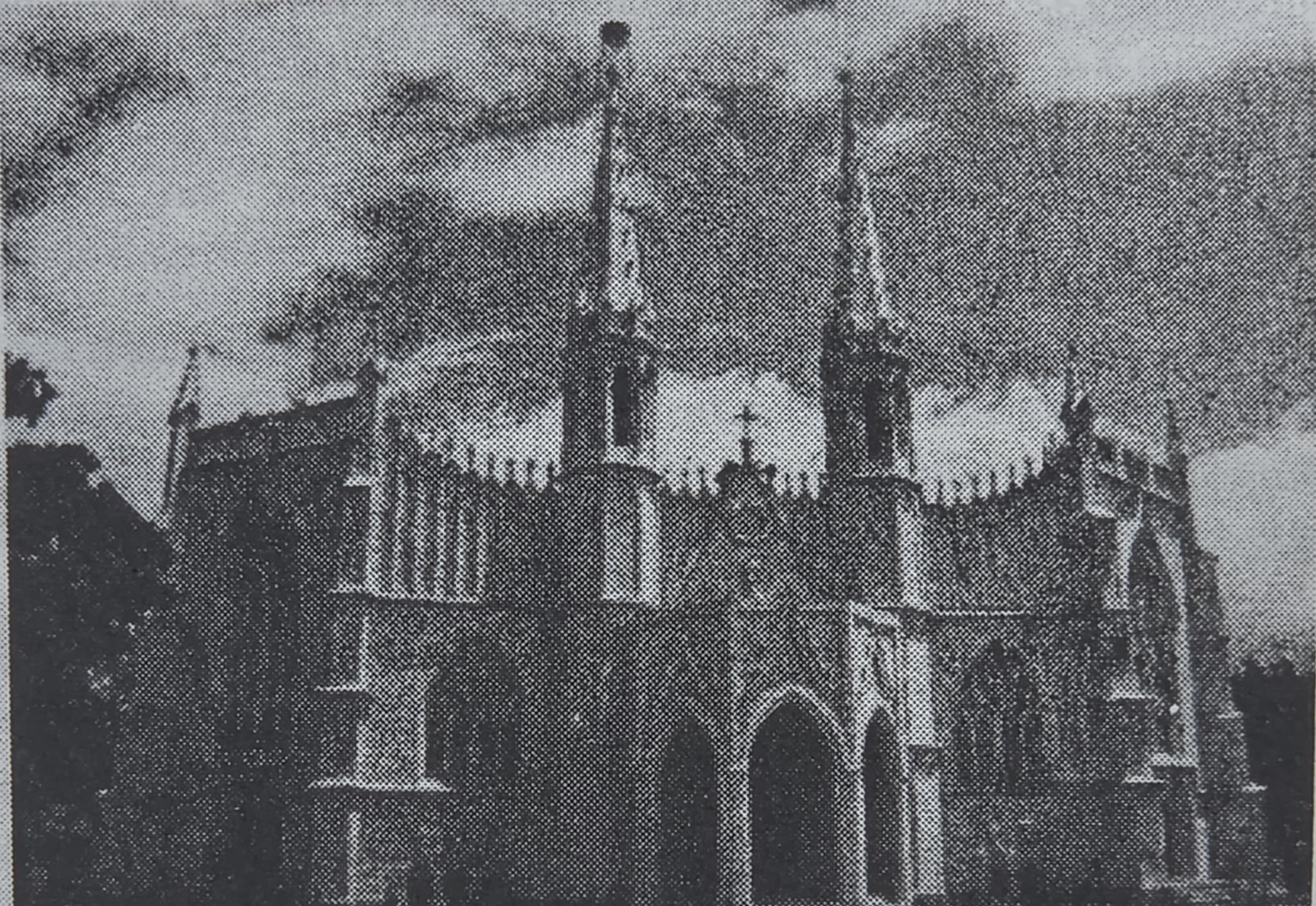
An archival black-and-white photograph of the great two-nave church at Vadakkankulam, its spires and pinnacles against a clouded sky

Our Heritage

A Story Carried by Generations

For over three centuries — since St. John de Britto raised his first thatched chapel in 1685 — Vadakankulam Matha has been a quiet witness to the faith of countless families, festivals, and silent prayers offered before Our Blessed Mother.

The Story of Little Rome

For more than three centuries the story of Vadakkankulam has been written under the roof of one church and around the love of one Mother. From a Christian woman's roadside cross in a southern forest to the unique two-nave "Little Rome" where Our Lady once wept, this is the living history of the Holy Family Shrine, Vadavai Matha.

A Clearing in the Forest — 1542–1544
A Clearing in the Forest — 1606
A Clearing in the Forest — c.1680
A Clearing in the Forest — 1685
A Clearing in the Forest — 1685–86
A Clearing in the Forest — 3 February 1693
A Clearing in the Forest — 1693

1542–1693

A Clearing in the Forest

Out of St Francis Xavier's coastal mission and St John de Britto's daring inland journeys, a Christian settlement took root around one devout woman's roadside cross in a southern forest.

A Clearing in the Forest — 1542–1544

01 / 08

1542–1544

St Francis Xavier on the Pearl Fishery Coast

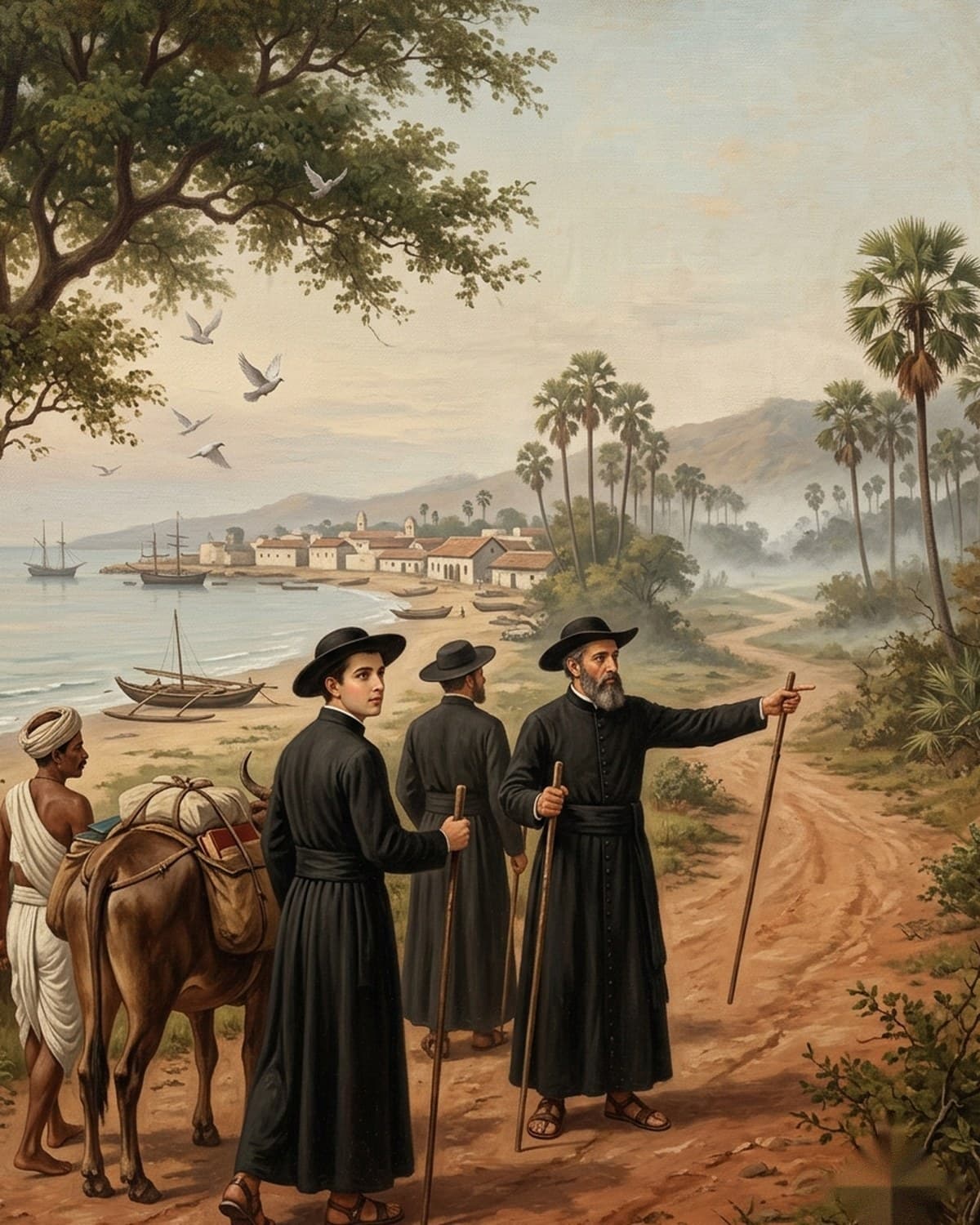
St Francis Xavier reached the Parava pearl-fishing coast towards the close of 1542 and found a coast already baptised: a decade earlier Fr Michael Vaz and his priests had received into the Church, it was said, twenty thousand souls in thirty villages. Xavier came to teach them, going bell in hand from village to village with the Creed and the prayers in Tamil, until all thirty had been visited. No inland village, Caldwell notes, appears to have joined that coastal movement.

DocumentedCaldwell 1881
A Clearing in the Forest — 1606

02 / 08

1606

The mission that turned inland

Christianity in these years “lay entrenched without the walls of India” — held to the coast. On 10 November 1606 a small party set out from Tuticorin for Madurai; among them the Roman Jesuit Roberto de Nobili, who made headway only after putting off European dress for the life of a sannyasi, “one who resigns or abandons all”. It was to the charge of that inland Madurai Mission that St John de Britto succeeded in 1683, and from it he came south.

A Clearing in the Forest — c.1680

03 / 08

c.1680

Santhaayi Ammaiyar settles the forest clearing

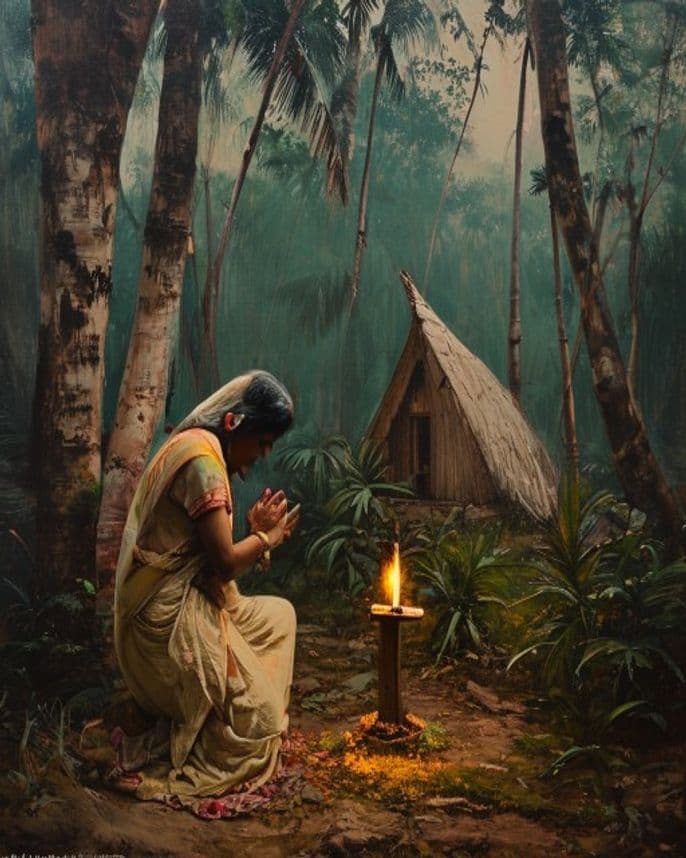
Around 1680 a devout Christian woman, Santhaayi (Sandhai) Ammaiyar, came with her family from Thoppuvilai and made her home in what was then only forest, full of bushes, trees and pits. Being firm in her Catholic faith, the parish's own history records, she raised a little roadside Crusadi, a cross-shrine, opposite her door, and a Christian settlement began to gather around her faith.

A Clearing in the Forest — c.1680

04 / 08

c.1680

A wayside cross on the kingdoms' road

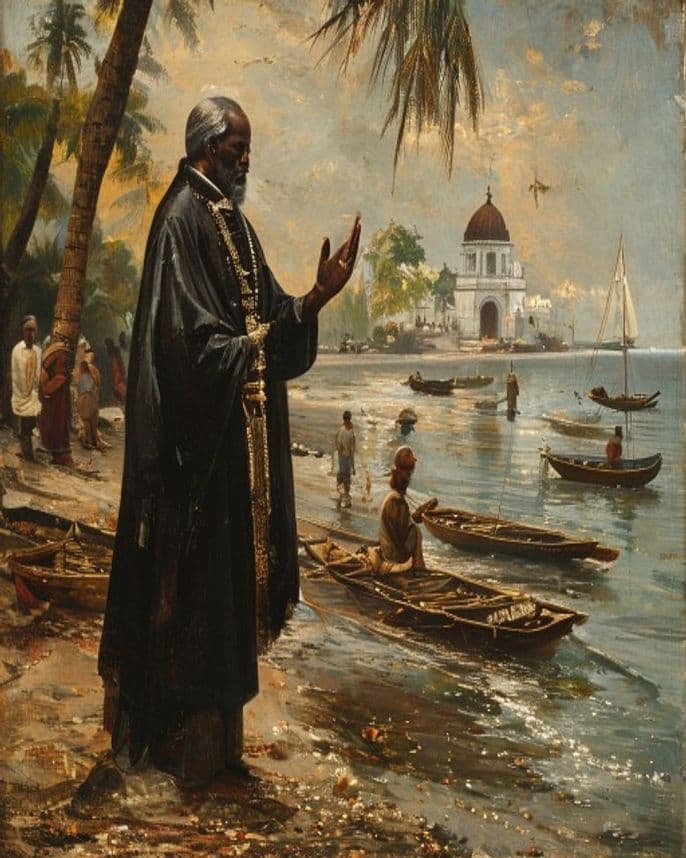
Vadakkankulam, "the northern tank," lay on the forest path between Travancore and the Pandyan country, a natural halting place for travellers and seekers of the faith. While gathering cotton in the fields, Santhaayi met a priest on horseback and begged him to bless her house and her Crusadi, by parish tradition St John de Britto himself.

A Clearing in the Forest — 1685

05 / 08

1685

A congregation, and a first chapel

By 1685 there was a Christian congregation in this clearing. The colonial gazetteer records that St John de Britto, known to Tamils as Arulanandar, "had penetrated as far south as Vadakkankulam," and that a congregation "appears definitely to have been formed by 1685." The chapel is the parish's own memory: its history records that de Britto raised a small chapel here and consecrated it to the Holy Family, the name the parish has borne ever since.

A Clearing in the Forest — 1685–86

06 / 08

1685–86

About two hundred baptised

The parish's own history records that on the same occasion as the chapel about two hundred people received baptism, the first great harvest of Vadakkankulam. It dates this to 1685; Bishop A. Stephen's jubilee message of 2022 puts de Britto's coming, the baptisms and the church together in 1686. The colonial gazetteer, writing from outside the parish, gives no number — only that a congregation "appears definitely to have been formed by 1685" — and it has de Britto called away to Kumbakonam, not returning.

A Clearing in the Forest — 3 February 1693

07 / 08

3 February 1693

The letter from the prison of Oriyur

On the eve of his death St John de Britto wrote from prison to his brethren, through their common superior. A straw served for his pen; his ink was powdered coal moistened with his spittle. “The only crime I am accused of is, that of having taught the law of Jesus Christ… as this crime is a virtue, the punishment cannot be otherwise than honourable to me.” He signed “your unworthy servant… From the prison of Orejour, the 3rd of February, 1693.”

A Clearing in the Forest — 1693

08 / 08

1693

Martyrdom of St John de Britto at Oriyur

On 4 February 1693 the founder of the Vadakkankulam mission was beheaded for the faith at Oriyur in the Marava country, aged forty-five. Canonised in 1947, Arulanandar is honoured here as the parish's founding saint, his blood the seed from which the community grew.

The First Inland Parish — 1698
The First Inland Parish — 1709
The First Inland Parish — 1712–1713
The First Inland Parish — 1714

1698–1740

The First Inland Parish

Under its own pastors and the Society of Jesus, the forest clearing flourished into the senior interior congregation of the whole southern mission.

The First Inland Parish — 1698

01 / 04

1698

The first parish priests

From around 1698 Vadakkankulam received its own dedicated pastors, and from this point the forest clearing was a true parish shepherded by an unbroken line of priests. It was growing into the first major inland Catholic parish within the lands of what is now the Diocese of Thoothukudi.

The First Inland Parish — 1709

02 / 04

1709

The parish appears in writing

The earliest document of its own century to name this place is the Jesuit Annual Letter of 1709. A fragment of it, printed by Bertrand, shows Fr Maria Xavier Borghese “at the head of the district of Vadakencoulam”, and says of him: “He labours for the conversion of the heathen with an admirable zeal; the ardour of his spirit supplies for the strength of the body.” Auguste Jean names the same man in the same charge, “near Cape Comorin”.

The First Inland Parish — 1712–1713

03 / 04

1712–1713

A remarkable harvest of souls

In just two years around 1712–13 nearly eight hundred adults were baptised at Vadakkankulam, besides many children, as the inland mission flourished. What had begun with two hundred under a thatched roof was now one of the great Christian communities of the southern frontier.

Parish traditionParish history 2026
The First Inland Parish — 1714

04 / 04

1714

A Jesuit residence on the frontier

By 1714 the flourishing congregation was recognised among the senior interior stations of the Society of Jesus and established as a Jesuit residence in its own right. Bishop Caldwell's history credits Fr Brandolini with founding the congregation here, marking Vadakkankulam as the first great inland parish of the region.

The Statue and the Saint — 1742–43
The Statue and the Saint — 1745
The Statue and the Saint — 1749
The Statue and the Saint — c.1749
The Statue and the Saint — 1752
The Statue and the Saint — 1773–1775

1741–1775

The Statue and the Saint

The golden age of Fr Buttari: a Marian statue carried ashore from the sea, the baptism of a future saint, and the first lasting church rising in the form of a cross.

The Statue and the Saint — 1742–43

01 / 07

1742–43

The statue arrives from the sea

In the years 1742–43 a wooden box stencilled "To Vadakankulam, From Portugal" and holding carved images of Our Lady was carried by the sea currents and cast ashore at Kootapuli. Fishermen brought it to the parish priest, Fr John Baptist Buttari, who kept one image for Vadakkankulam, gave a second to Kamanayakkanpatti and the third into the Bishop's care. The statue kept here, Our Lady of the Assumption, is the very image that would one day weep.

The Statue and the Saint — 1745

02 / 07

1745

St Devasahayam baptised here

On 14 May 1745, after nine months of instruction, Fr Buttari baptised Neelakanta Pillai, a Nair officer from the court of Travancore, in the Holy Family Church, giving him the name Devasahayam ("God is my help"); his godfather was the catechist Gnanaprakasam Pillai. The Holy See itself confirms Vadakkankulam as the place of this baptism, the single best-documented fact in the parish's whole history.

The Statue and the Saint — 1749

03 / 07

1749

Foundation of the first stone church

In 1749 Fr Buttari held the kankol (foundation-stone) festival for a larger, lasting church, for the Catholic community had grown too great for de Britto's old thatched shelter. The parish's own history says it was raised of broad bricks brought from Perungudi. It was the beginning of the first permanent church here, whose bell, half a century later, would summon the village to the weeping of Our Lady.

The Statue and the Saint — c.1749

04 / 07

c.1749

Timber for the church, and an arrest

Fr Buttari's church was rising, and the timber ran short. To help his priest, Devasahayam went to a man at the king's court, long his friend, for leave to cut wood in the royal forests. They fell to arguing over religion instead, and the man left threatening his life. The Jesuit history of 1894 calls this the incident that made the gathering storm break: by his intrigues a royal warrant followed, and Devasahayam gave himself up without resistance.

The Statue and the Saint — 1752

05 / 07

1752

The cross-shaped church completed

In 1752 the brick church was finished, built in the form of a cross and facing east toward the rising sun, the work begun by Fr Buttari and carried to completion by Fr Clement Thomassini. The parish's own history records that in Thomassini's time the great Feast of the Assumption took root here as its principal festival. Bertrand, writing from within the mission, gives this church a different titular feast: St Francis Xavier's, kept with a great novena every December.

The Statue and the Saint — 1752

06 / 07

1752

Martyrdom of St Devasahayam Pillai

After three years of cruel suffering, paraded on a buffalo, scourged and chained for months to a tree in the wilderness, Devasahayam was shot on 14 January 1752 at the Travancore lines by the Aralvaimozhi gap, dying with the names of Jesus and Mary on his lips. The old accounts do not name the hill; Kattadimalai is the name it carries from the national shrine that stands there now. Of the relics kept at Vadakkankulam, the Jesuit historian Auguste Jean wrote in 1894 that the church held a part of his garment and the chains with which he was bound; the diocese records that the head-cloth he wore is kept here too. His wife, baptised Gnanapoo Theresa, lies buried in the parish cemetery.

The Statue and the Saint — 1773–1775

07 / 07

1773–1775

The Jesuits suppressed; the old mission ends

In 1773 Pope Clement XIV suppressed the Society of Jesus throughout the world. The Jesuits who remained in Tinnevelly — here, at Talai, at Manapar — "died one by one," Caldwell records, and their places were supplied by priests from Goa. The last of the old Jesuit fathers here, Fr Clement Thomassini, felt his end approaching and had himself carried to Fr Antoine Douarte at Talai, where he died in 1775, aged seventy-five.

The Weeping Madonna — 1775–1838
The Weeping Madonna — after 1775
The Weeping Madonna — 1794
The Weeping Madonna — 1801
The Weeping Madonna — 1803
The Weeping Madonna — 1803–1817
The Weeping Madonna — 1803

1775–1838

The Weeping Madonna

Through sixty-three quiet years without a resident Jesuit, the parish kept the faith on its own, and on one October Friday in 1803 Our Lady wept above the altar before the gathered village.

The Weeping Madonna — 1775–1838

01 / 09

1775–1838

Sixty-three years without a Jesuit

For sixty-three years after the last Jesuit father, Clement Thomassini, died in 1775, no Jesuit served Vadakkankulam. It was not left to itself. Bishop Caldwell's history records that the Jesuits left in Tinnevelly, this parish among them, "died one by one, and their places were supplied by native priests from Goa." The parish's own roll names the pastors who followed under the Bishop of Cochin — Deva Varadhanar, Ignatius, John Louis Cardoza and their successors.

The Weeping Madonna — after 1775

02 / 09

after 1775

The father they kept

They did not let go of the priest they had lost. Fr Thomassini had himself carried away to die in 1775, aged seventy-five. Ninety years later Bertrand still writes of him in the present tense: “The Christians venerate him as a saint, give his name to their children, and visit his tomb with an extreme devotion.” Even the non-Christians, he adds, invoke him in their distress, holding that his intercession brings the rains down upon their harvests.

The Weeping Madonna — 1794

03 / 09

1794

The village in a printed book

In 1794 the village turned up in a book printed at Rome. Paulinus a S. Bartholomaeo’s India Orientalis Christiana sets down at p.158, among the churches subject to the Bishop of Cochin: “XIV. Vadakencollam.” At p.117 the same name is placed on the Cape Comorin coast, “in promontorio Comorino”. It is a name in a list and claims nothing more — but it is this parish in a European printed book, nine years before Our Lady is said to have wept.

DocumentedPaulinus 1794
The Weeping Madonna — 1801

04 / 09

1801

Under a new sovereign

Two years before the weeping, the village changed sovereign. "On the 31st July, 1801," the district gazetteer records, an agreement with the new Nawab handed "the sole and exclusive administration" of the Carnatic "to the Company in perpetuity". The same day Mr Lushington was appointed first Collector of Tinnevelly "under the new sovereign power", and a week later reported the province brought in "without the smallest disturbance".

DocumentedPate 1917
The Weeping Madonna — 1803

05 / 09

1803

The weeping of Our Lady

By parish tradition, on a Friday forenoon in Aippasi, Tamil year 979, Savarimuthu Pillai came to pray before the statue of Our Lady of the Assumption above the altar, its niche doors open. As he prayed, the parish's own history records, a transparent cloud gathered about her, her eyes rose to heaven and filled with tears, and her folded hands opened and stretched outward. That history dates the Friday to 21 October; the feast is kept on the 23rd.

The Weeping Madonna — 1803

06 / 09

1803

The whole village came and wept

The catechist Madurendira Annaviyar climbed to the altar and wiped the tears, but they would not stop; then the church bell was rung and the whole village hurried in at that unusual hour. Gazing on the marvel, the people wept and sang the old penitential chants, "Parce Domine, parce populo tuo" ("Spare, O Lord, spare Your people"), until at last the statue returned to its ordinary look.

The Weeping Madonna — 1803

07 / 09

1803

The witnesses who saw and affirmed

The wonder was seen by many eyes: the catechists Zacharias, Vyagappar and Yagappar Pillai, and the European laywoman Henriette Bilderbeck, who examined the statue closely and affirmed all three signs, the clouding face, the tears, and the opening hands. That same day the parish priest, Fr John Louis Cardoza, with another priest and Henriette, declared it an extraordinary marvel, a treasured local tradition the parish has guarded faithfully ever since.

The Weeping Madonna — 1803–1817

08 / 09

1803–1817

The family of the miracle morning

The Bilderbecks of the 1803 account — the European resident Savarimuthu Pillai had come to visit, and Henriette who examined the statue — were flesh and blood, and modern scholarship can now name the household: Christopher Bilderbeck, born about 1758, a merchant of European descent who settled at Vadakkankulam late in the eighteenth century and died in 1817. A son, John, was born in 1809, six years after the weeping. When John died in 1880, the journal of an English missionary society recorded of him that he was "born in India… of a Roman Catholic family, and trained for the priesthood of that Church."

The Weeping Madonna — 1803

09 / 09

1803

What the parish does not claim

It is right to say what this rests on. Every account of 1803 descends from one printed book: Léon Besse’s La Mission du Maduré (Trichinopoly, 1914). It has never been digitised; four copies are known, and nobody on this project has read them. The weeping has never been submitted to Rome; no Vatican commission has examined it. What the parish holds is a dated, named, locally authenticated event, honoured for two centuries. It claims no more.

DevotionBesse 1914
The Great Two-Nave Church — 1838
The Great Two-Nave Church — 1839
The Great Two-Nave Church — 1848
The Great Two-Nave Church — 1838–1855
The Great Two-Nave Church — 1855
The Great Two-Nave Church — 1855–1872
The Great Two-Nave Church — 1861
The Great Two-Nave Church — 1863
The Great Two-Nave Church — c.1864
The Great Two-Nave Church — 1872
The Great Two-Nave Church — 1873 or 1875

1838–1872

The Great Two-Nave Church

When the French Jesuits returned, the old chapel gave way to a church "probably without equal in the world": the unique open-compass church of two converging naves meeting at one altar.

The Great Two-Nave Church — 1838

01 / 11

1838

The French Jesuits return

After more than sixty years without a resident Jesuit, the restored Society of Jesus came down into the southern mission and Vadakkankulam returned to Jesuit care. On their very first visit the new French fathers found the people seated apart by caste in the old chapel, a wound the parish would spend a century learning to heal.

The Great Two-Nave Church — 1839

02 / 11

1839

The novena and feast of St Francis Xavier

In 1839 the superior of the Madurai mission, Fr Joseph Bertrand, kept the great novena and the solemn feast of St Francis Xavier at Vadakkankulam. The bishop, then on visitation, asked him to part from him for it, and to go on afterwards inland to Palamcottah. Bertrand's own journal records the day: on horseback at half past two in the morning, at the church by eight on 23 November, and mass to open the novena and the year's administration of the sacraments.

DocumentedBertrand 1865
The Great Two-Nave Church — 1848

03 / 11

1848

Bishop Canoz asks the village for a church

The great church began with a request. Auguste Jean records that on his pastoral tour of 1848 Bishop Alexis Canoz, Vicar Apostolic of Madurai, “visited Vadakenkoulam” — the parish’s own history dates the visit to 21 June. It is that history alone, and no outside source, which remembers what he asked for: that the people begin gathering money for a large new church. Seven years later he came back to bless its foundation stone.

The Great Two-Nave Church — 1838–1855

04 / 11

1838–1855

The benefactors the parish remembers

To the years of gathering, the parish's own history attaches a story of gratitude: the Bilderbeck family — the name reaching the parish books garbled as "Hentriett Belderk" — childless through twenty-seven years of marriage, prayed to Our Lady of this church, were granted a child, and gave generously toward the new building. The jubilee souvenir keeps the same memory in Tamil: within a year a son was born, and their joy passed all measure. It is memory, and this page records it as memory: no printed history we have opened names any benefactor of this church — Auguste Jean credits it to Fr Grégoire's "persevering energy" alone — and Christopher Bilderbeck himself had died in 1817, thirty-eight years before the foundation stone. Whether Besse's unread chronicle records the family's gift is one of the questions his book still holds.

The Great Two-Nave Church — 1855

05 / 11

1855

The foundation stone of the great church

On 9 August 1855 Bishop Alexis Canoz of Madurai blessed the foundation stone of the present Holy Family Church. The parish's own history records that one of its priests composed for the occasion the bold motto of the whole design: "Templum sit duplex, ara sed una" — let the temple be twofold, but the altar one; may both castes be of one faith and one mind. The verse comes down to us in the parish's books; no one has read it off the stone.

The Great Two-Nave Church — 1855–1872

06 / 11

1855–1872

Fr Joseph Grégoire, apostle of Vadakkankulam

For some seventeen patient years the work was driven by Fr Joseph Grégoire SJ, the man who gave this community a church one historian called "probably without equal in the world." It is his Jesuit chronicler Auguste Jean, and he alone, who calls him "the apostle of Vadakenkoulam." The Jesuit lay-brother Joseph Bergenthal engineered its twenty-four self-supporting arches, turned in lime and palm-toddy mortar without cement, iron, or a single wooden beam to hold them.

The Great Two-Nave Church — 1861

07 / 11

1861

Two bells cast in France

The parish's twin bells were cast in France in 1861, the gift of a benefactor named Casimir Grégoire — the bell in the tower still bears his name in its bronze. Packed in crates, they came by sea to Madras and up through Tirunelveli, and were finally hung in 1872, one in each of the church's two new towers, their joined ringing giving, the people still say, a sweetness of sound heard nowhere else in this land.

The Great Two-Nave Church — 1863

08 / 11

1863

A tomb beside the church

What the long building cost is written beside the church. “The piety of the Christians of Vadakenkoulam raised, near their church, a modest tomb to Fr Eugène Rossignol, who died on 25 January 1863” — he had caught the disease nursing the cholera-stricken Christians of Callikoulam. Fr Victor Delpech, who anointed the dying Fr Grégoire aboard ship, came back and died here himself, in the arms of Fr Pouget. Dessal gives the day as 16 January 1887; Auguste Jean says only that it was a Saturday.

The Great Two-Nave Church — c.1864

09 / 11

c.1864

A convent of native nuns

Setting down the mission's returns for about 1864, a British district manual lists three convents in the whole Jesuit mission of Tinnevelly: one at Tuticorin, one at Adeikalapuram, and "A Convent for Native Nuns at Vadakankulam" — the only one away from the fishery coast. Sisters were living here while the great church was still building. No parish record dates a convent here so early; it is the district manual alone that remembers them.

DocumentedStuart 1879
The Great Two-Nave Church — 1872

10 / 11

1872

The two-nave church blessed

In 1872 the finished Holy Family Church was blessed — by Bishop Canoz, the parish's own history records. The district gazetteer sets the building down plainly: "two converging naves which meet in a common chancel." Auguste Jean called the plan an open compass: two naves splayed apart at their doors, drawing nearer, meeting at one shared sanctuary. The parish's history adds two octagonal towers of ninety-two feet, and vaults painted with dyes drawn from plants and trees.

The Great Two-Nave Church — 1873 or 1875

11 / 11

1873 or 1875

Fr Grégoire dies at sea

He did not long outlive the church. “What the building of this sanctuary cost him in cares and fatigues, God alone knows,” wrote his chronicler. Sent home on his doctors’ advice, Fr Grégoire never reached the end of the voyage: he died in the crossing of the Red Sea, anointed by Fr Victor Delpech. His two chroniclers agree on the day and differ only on the year: both put his death on 19 September — Auguste Jean in 1873, Dessal in 1875. He had been thirty years a missionary.

Little Rome — 1891
Little Rome — c.1910
Little Rome — 1881–1923
Little Rome — 1923
Little Rome — 1926
Little Rome — 1930
Little Rome — 1944

1891–1944

Little Rome

A festival chariot, a long journey toward unity across the two naves, the new Diocese of Tuticorin, and the loving title that became the village's second name.

Little Rome — 1891

01 / 07

1891

The festival chariot is built

The parish's own history records that a festival chariot was built in 1891 — a thirty-five-foot timber ther, which that same account describes as carved of jackfruit, teak and neem by local sculptors. It was in use for more than a hundred years; the old car now stands as the cradle of the Pilgrims' Mother, and a newly designed ther has borne her since 2014. The chariot procession still draws roughly a hundred thousand pilgrims, many crossing over from Kerala, in the small hours of 15 August.

Little Rome — c.1910

02 / 07

c.1910

The partition wall comes down

In the church Fr Grégoire had built with two separate naves, a wall once kept the castes from even seeing one another at worship. About 1910 Fr Adrien Caussanel, the fierce, ascetic priest who lived on milk and bananas for eighteen years, demolished that partition so that for the first time all castes stood and sang together as one people. It was a true act of reconciliation, a turning toward the unity the parish bears as its name today.

Little Rome — 1881–1923

03 / 07

1881–1923

Book 450, and the man who made it

The Jesuit archives at Shembaganur still hold the volume: Book 450, “Diary by Fr A. Caussanel S.J. at Vadakenkulam, 1881–1923”. It is not a diary kept here day by day from 1881. Caussanel was ordained only in 1884 and reached India in 1888; the Society’s Roman catalogues set him at Vadakankulam in 1914 and elsewhere before and after, and the parish’s own roll of its priests gives him the years 1910 to 1919. What the Jesuits’ own magazine says he did here is the better story: he wrote “diaries, a history of the country”, and he “searches out the old manuscripts and deciphers them”. Book 450 is that work — this parish’s past gathered up out of older papers by a man who lived among them. It survives; we have not yet read it.

Little Rome — 1923

04 / 07

1923

The Diocese of Tuticorin is born

In 1923 the Diocese of Tuticorin was erected, and Vadakkankulam passed out of the old Diocese of Trichinopoly into the new see under its first bishop, Francis Tiburtius Roche SJ. The Catholic Directory of the following year sets the parish down: “Vadakankulam (Tinnevelly Dt.) — Revv. Y. Ignatius, G. Michael, Asst. — Cath. 4,765, vills. 17: Churches: brick 1, clay 4.” Neither priest is a Jesuit: the parish’s care had passed to the diocesan clergy.

Little Rome — 1926

05 / 07

1926

"Little Rome" — Chinna Romapuri

In 1926, struck by the grandeur of the Holy Family Church, the first Bishop of Tuticorin, Most Rev. Dr Francis Tiburtius Roche, SJ, lovingly named Vadakkankulam "Chinna Romapuri," Little Rome. The title has been the village's proud second name ever since, drawing pilgrims who come to see a church likened to the great basilica of Rome.

Little Rome — 1930

06 / 07

1930

The old sacristan and the Pope

In Rome, Bishop Roche laid his people’s homage before Pope Pius XI, who sent mementoes to the most deserving Christians of Tuticorin. To the old sacristan of Vadakenkoulam — brother of a vicar general and of a convent superior, still at eighty-two serving the church — went the Bene Merenti medal. The Jesuits’ magazine printed his years and his office, not his name. In the same audience the Pope spoke of the bishop’s own family: “Oh! the beautiful family,” he said; “two priests and a bishop. What a happy mother!” — and sent a gold rosary to Bishop Roche’s mother.

Little Rome — 1944

07 / 07

1944

The Rosarian Fathers at Fatima Giri

The Rosarian congregation — the Servants of the Rosary, founded in Jaffna in 1928 — records that its first house in India, the Fatima Giri Ashram, was established here in 1944 by Antony Susainather, whom the order honours as a Servant of God. That this village is the birthplace of the Rosarians in India rests on the order's own account alone. The Fathers still keep their house at Fatima Giri, and with the Servite and Bethany Sisters they remain part of parish life today.

A Town of Learning — 1892
A Town of Learning — c.1922
A Town of Learning — 1970

1892–1970

A Town of Learning

Sisters teaching the village girls their letters, a school for lace and the needle, and at last a hospital of forty beds: the ladder of learning and healing that a poor parish built for itself.

A Town of Learning — 1892

01 / 03

1892

The sisters and the girls' school

In April 1892 the Sisters of Our Lady of the Seven Sorrows — Indian religious, formed at Trichinopoly in 1876 — numbered sixty-five, and the Jesuit historian Auguste Jean names Vadakkankulam among the four houses they kept beyond that city. Their special work, he writes, is the education of girls, and everywhere "they direct flourishing schools." The Society's Roman register sets the priest here down as chaplain of that convent of Indian nuns and director of its school — in 1900, and again in 1914 under Fr Caussanel.

A Town of Learning — c.1922

02 / 03

c.1922

The lace and sewing institutes

The parish's own history records that an inspector came to the sisters' needlework school in 1921, that from 1922 the sisters were teaching needlework, embroidery, lace, knitting and dress-making, and that in 1966 the tailoring school passed wholly into their charge. Those dates are the parish's account of itself. The school is not in doubt: the diocese still names the R.C. Lace Industrial School among the works of this parish, and the Osanam Sewing Institute stands beside it in the parish's own roll.

A Town of Learning — 1970

03 / 03

1970

The Bethany Sisters and St Thomas Hospital

Fr Maria Gnanam, then parish priest, saw that his people needed medical care and invited the Sisters of the Little Flower of Bethany. Four sisters came on 27 July 1970 and began their healing ministry in a rented house; with help from Misereor they built St Thomas Hospital where it stands today. It has grown to forty beds and an operating theatre, and by the sisters' own account it serves twenty-five to thirty villages. They keep it still.

Parish traditionBethany Sisters
The Shrine and the Saint — 1993
The Shrine and the Saint — 2014
The Shrine and the Saint — 2021
The Shrine and the Saint — 2022
The Shrine and the Saint — 2012–2025
The Shrine and the Saint — present day

1993–present

The Shrine and the Saint

Declared a shrine, crowned with a new flag-mast, and rejoicing at the canonisation of the saint baptised within its walls, Little Rome lives on as a thriving Marian pilgrimage town.

The Shrine and the Saint — 1993

01 / 06

1993

Declared a Shrine

On 6 August 1993 Bishop S.T. Amalanathar of Tuticorin consecrated the Holy Family Church and proclaimed it a sacred shrine. Every witness of that year names it by the old dedication, to the Holy Family; the Marian style it carries today — the Shrine of Our Lady of Assumption — is first found in the diocese's letters of 2022. With the honour came a monthly First-Saturday devotion of novena and adoration that pilgrims keep to this day.

The Shrine and the Saint — 2014

02 / 06

2014

The festival chariot newly designed

In 2014 the parish had a new festival ther of the Assumption designed and built. It took the place of the thirty-five-foot car made by local Vadavai sculptors in 1891, which had carried Our Lady for more than a hundred years and now rests as the cradle of the Pilgrims' Mother. In the same years the Calvary chapel of the Apparition shrine was completed and statues of St Devasahayam and St Arulanandar were set up.

The Shrine and the Saint — 2021

03 / 06

2021

The flag-mast blessed

The parish's own jubilee souvenir records that on 6 August 2021 Bishop Stephen Antony consecrated the flag-mast (kodimaram), set up under the parish priest Fr John Britto. The date is the opening day of the ten-day Perunkoor feast, which runs to the Assumption on 15 August — and the same day of the year on which the church was declared a shrine in 1993.

Parish traditionThe parish's own record. No source outside this parish.
The Shrine and the Saint — 2022

04 / 06

2022

St Devasahayam Pillai, the first Indian lay saint

On 15 May 2022 Pope Francis canonised Devasahayam Pillai, baptised in this church on 14 May 1745, the first Indian layman ever raised to the altars. In 1894 the Jesuit historian Auguste Jean recorded that the church held a part of his garment and the chains with which he was bound. The diocese records that the head-cloth he wore as a Travancore court official is kept here; each 15 August it is exposed in a glass case for veneration.

The Shrine and the Saint — 2012–2025

05 / 06

2012–2025

Patron of the Indian laity

It neither began nor ended in 2022. Benedict XVI recognised the martyrdom in June 2012, and that 2 December Cardinal Angelo Amato beatified Devasahayam in his name at Nagercoil. Pope Francis recognised the miracle in February 2020 and canonised him in May 2022. Then, by a decree of 16 July 2025, Rome named him Patron of the Laity in India, proclaimed on 15 October. The man baptised in this church is patron now of every lay Catholic in the land.

The Shrine and the Saint — present day

06 / 06

present day

Little Rome today

Vadakkankulam today is an overwhelmingly Catholic town, and a remarkably literate one: the 2011 census puts the whole town at 9,220 people, 94 per cent of them able to read. The parish counts some 10,500 Catholics in around 4,000 families, organised through Basic Christian Communities; the diocese's own roll gives about 7,350 in some 1,600. The great August Perunkoor feast still draws close to a lakh of pilgrims for the chariot procession in the small hours of 15 August — the Tamil daily Maalaimalar reported as much in 2022, many of them crossing over from Kerala — and the parish keeps its faithful close through the monthly magazine Vadavai Matha Malar and its own live broadcasts.